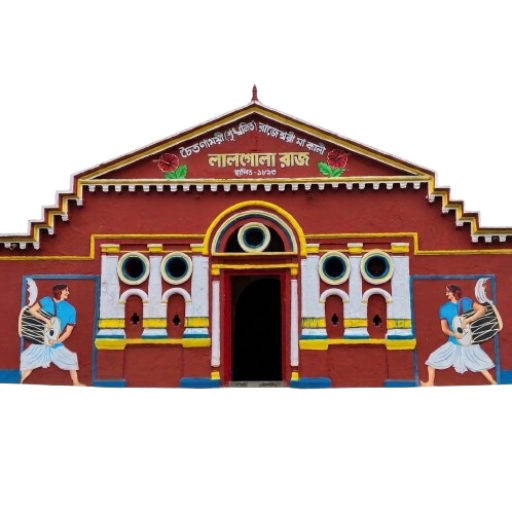
The Mother’s Home, Everyone’s Duty: A Development Proposal for Lalgola
The wall above the temple reads: Chaitanyamayi (Shrinkhalita) Rajeshwari Maa Kali, Lalgola Raj, established 1813. The Mother has been here for more than two hundred years. [Tradition] Local belief also ties this precinct to the memory of “Vande Mataram”. Yet today the roof of her home is cracked, and in the rains water stands on the verandah. She who shelters everyone like an umbrella cannot herself be sheltered from the rain.
This is not written to blame anyone. It is the heart of a devotee, together with a practical plan, so that all of us can make the Mother’s home shine again.
The picture today: everyone’s pride, no one’s duty
The question is simple, and still unanswered: whose home is the Mother’s home? Various parties have various claims, but there is no clear address for responsibility. As a result:
- There is no registered committee or caretaker; even a simple decision means keeping ten people happy.
- The Mother has no bank account and no PAN, so even when an organisation, public or private, wants to help, there is nowhere for the money to go. It cannot be given to any individual.
- Roof repair, drainage, lighting, drinking water, toilets, even a signboard at the gate: these minimum tasks keep waiting.
- At festivals, small children come and people of every faith take darshan. What a joy! But who cleans up afterwards? The Mother may have four arms, but there are not four people to serve her.
- Those who serve today do so on their own responsibility and at their own risk, because there are more people ready to find fault than to work.
Why the deadlock: holding up a gentle mirror
The truth needs to be said with humility. Every party has its reasons, and every party has something it can do.
Administration and government
In official eyes the precinct is often just a venue for cultural programmes. And because it is called “the royal family’s private temple”, no government grant comes; by rule, funds cannot be given to an individual either. In this gap in the rules, a shrine that carries a national memory lies neglected. If the administration wishes, it can surely find a way to close this gap.
The prison authority
Part of the Rajbari precinct today falls under the open correctional home. It is natural for the authority to have its own rules on jurisdiction. But if jurisdiction only means withholding permission, and not taking responsibility for upkeep, it is the Mother who loses.
The royal family
Lalgola Raj is our pride; their contribution is immense, and we are grateful from the heart. None of us wants that history to fade. Still, we humbly remind them that they have a family temple in Lalgola, where a lamp is lit every day, and that temple awaits their affection. If asking the public for donations hurts the family’s dignity, may the family itself show the dignified way.
We, the public
We are no less responsible. We share love for the Mother’s photos on social media, but do not come even one day with a broom. When someone takes an initiative, another’s ego is hurt, and sometimes politics creeps in. The Mother’s temple belongs to no party and no single person. It belongs to all.
A dream: Lalgola Matri Dham
The Ganga and the Padma, the Rajbari, the mango orchards of Kalkali, several temples centuries old: what does Lalgola lack? Not just a historic river-port town, Lalgola is a sacred land, a Matri Dham. Developed well, it can become a major heritage destination: the Mother’s glory will spread across the country and abroad, devotees will come to see the chained Mother, fairs and festivals will flourish, and Lalgola’s cultural standing and local economy will change.
The proposal: a step-by-step plan
Step 1 — Laying the foundation (first 3 months)
- One table for all: an open meeting of representatives of the royal family, the prison and district administration, the local panchayat, the purohits and devotees.
- A written understanding (MoU): without raising the question of ownership, clarify only the right to serve and maintain: who may do what, and whose permission is needed.
- A registered body: a public charitable trust, or a society under the West Bengal Societies Registration Act, 1961, with the royal family as honoured patrons.
- The Mother’s own account: a bank account and PAN in the body’s name; later 12A/80G registration under the Income Tax Act so donors get tax relief.
- Transparency: audited accounts published on the website every year.
Step 2 — Urgent repairs (3–6 months)
- A structural survey of the roof and walls by a qualified civil engineer; temporary waterproofing.
- Drainage for the verandah and courtyard; safe wiring and lighting.
- A trilingual signboard and history plaque at the gate.
- Drinking water, temporary toilets, a shoe stand and seating for elders.
- A weekly cleaning roster; bins and a plastic-free policy in the precinct.
Step 3 — Heritage conservation (6–12 months)
- Full documentation of the temple and precinct: measurements, photographs, old documents and memories.
- An application to the West Bengal Heritage Commission for heritage recognition.
- Restoration by heritage norms: suitable materials such as lime mortar, keeping old craftsmanship intact.
- Care of the trees and the dighi in the precinct.
Step 4 — Festivals, tourism and economy (1–3 years)
- An annual “Lalgola Matri Dham Utsav” and fair around Kali Puja: dhak, folk music, local food and crafts.
- A Lalgola heritage walk: the Rajbari temple complex, Raghunath Jiu, the Kalkali mango orchards and the banks of the Ganga–Padma.
- A small exhibition corner on the “Vande Mataram” tradition.
- Trained local youth as guides; new income for homestays and food stalls.
- Encouragement and training for young dhakis to keep the dhak tradition alive.
Step 5 — Everyone’s participation (ongoing)
- Seva requests, tokens, schedules and accounts, all open on the website.
- A volunteer team; at least one “Day for the Mother” every month.
- Everyone’s suggestions heard through the feedback form.
- Doors open to all, above religion, caste and party.
Special plan: “Lalgola Matri Dham” spiritual-heritage tourism and employment
The core point: in many places, temples that are newer and smaller draw huge numbers of devotees every year because of planned outreach, infrastructure and management. Lalgola already has what most of them lack: a royal heritage of more than two centuries (established 1813, per the signboard), a vast Rajbari campus, old architecture, folk tradition linked to “Vande Mataram” [Tradition], the banks of the Padma and Ganga, mango and lychee orchards, and a unique border landscape. What is missing is planning and initiative. This proposal aims to bring all these assets together under the umbrella of spirituality, to make Lalgola Matri Dham a pilgrimage-tourism destination known across the state, the country and abroad, and to create large-scale employment for local people.
1. Why now: context and opportunity
- The nation is marking 150 years of “Vande Mataram” (7 November 2025 – 7 November 2026). Local research on the link between the Lalgola Rajbari Kali and “Anandamath” has appeared in the press, so this is the best moment for recognition. [Ref 1] [Ref 2]
- The Union Ministry of Tourism’s PRASHAD scheme gives financial assistance, through state governments, for infrastructure at pilgrimage and heritage sites. [Ref 3] [Ref 4]
- The West Bengal Homestay Policy 2026 and the state tourism incentive scheme open direct opportunities for local families and entrepreneurs. [Ref 5] [Ref 6]
- Lalgola is a railway terminus on the Padma, at the India–Bangladesh border, and part of the Rajbari houses an open correctional home. Connectivity and name recognition already exist. [Ref 7]
2. Developing the temple complex and the Kalkali area
- Main temple: scientific conservation of the roof and walls (supervised by a heritage architect), drainage, electrical and fire safety, a bhog kitchen and a prasad counter.
- Devotee facilities: clean toilets (women- and disability-friendly), drinking water, a shoe room, shaded queues, ramps, seating for elders and first aid.
- Interpretation centre: a small museum of royal history, the Vande Mataram tradition [Tradition], old documents and photographs, with trilingual (Bengali, English, Hindi) plaques and QR audio guides.
- Kalkali area: riverside paths, lighting, seating, greening, a platform for evening aarti/Ganga aarti, and a small haat and food stalls that follow environmental rules.
- Access: signage from the station to the temple, a toto stand, parking and a “heritage walk” route.
3. Tourism circuits: spirituality with nature and culture
| Circuit | What it offers | Points to note |
|---|---|---|
| Matri Dham darshan | Temple, Rajbari campus (from outside), interpretation centre, heritage walk | Rules and permission for the correctional-home area |
| Ganga–Padma ghats | Various Ganga ghats, Khandua Padma, the south bank of the Padma; sunrise and sunset, boat rides | Life jackets, licensed boatmen, monsoon caution |
| Sagardighi light reflection | A viewpoint for the evening scene of the Sagardighi thermal plant’s lights reflected on the water [local experience] | The plant is operated by WBPDCL [Ref 8], not NTPC; viewing from a distance only, no entry to the industrial area |
| Border road ride | Cycle, bike or toto rides along the border patrol road, with Padma char lands and village life | Nothing without BSF and administration permission; fixed timings and routes |
| Mango orchard ride | Cycling or walking trails through mango orchards, with snacks in the orchard | Consent of orchard owners and revenue sharing |
| Mango and lychee tourism | In-season orchard visits, hand-picking, a mango-lychee festival, a display of Murshidabad heritage mangoes including Kohitur | Kohitur and Murshidabad’s ~200 mango varieties have drawn national and international attention [9] [10] [11] |
4. “6 seasons, 6 faces of the Padma”: a year-round calendar
- Summer: calm, wide sandbanks; dawn ghat walks; mango and lychee season begins.
- Monsoon: the full, swollen Padma, viewed only from safe viewpoints; boats stopped or controlled.
- Early autumn (Sharat): kash flowers and Durga Puja; cultural evenings on the ghats.
- Late autumn (Hemanta): Kali Puja and Deepavali, the main festival of the Matri Dham, with ghats lit by lamps.
- Winter: misty mornings, migratory bird watching [to be verified], the best time for picnics and heritage walks.
- Spring: Dol, and orchards in blossom; photography and folk-music festivals.
Separate photos, short videos and packages for each season, so visitors come back again and again, not just once.
5. Park, local-product market, boating at Kalkali and beautification of the whole area
A huge area of land in Lalgola’s royal precinct has lain unused for years, full of weeds, darkness and neglect. This land could be the Matri Dham’s greatest asset. The proposals below are conceived as parts of one integrated master plan. No heritage structure will be demolished; old buildings will be restored and adapted to new uses (adaptive reuse).
a. Two beautification corridors
- Kath Mill to Kalkali: a paved riverside promenade, solar lighting, shade trees, benches, waste bins, signage and a sunset viewpoint, with green slopes to protect the riverbank.
- Raghunath Mandir to the mango orchards: a “heritage and green path” with separate lanes for walking and cycling, heritage plaques and QR information along the way, and a rest and snack area at the edge of the orchards.
- Together the two corridors link the temple, ghats, orchards and royal heritage into one walkable circuit. Visitors walk, stop and buy, and vehicle congestion falls.
b. Matri Dham Udyan (park)
- A children’s play area (safe equipment, soft flooring) and a walking track for elders.
- A sacred and medicinal plant garden (bel, jaba, tulsi, ashok, kadam and others), each with a name and information plaque.
- Restored water body, lawns, shaded seating, and an open stage for evening bhajans and folk music.
- Clean toilets, drinking water, solar lights, a plastic-free zone, and a minimal entry fee for maintenance.
c. Local-product market complex
- A neat “Matri Dham Haat and Emporium”: mango and lychee products (pickles, aamsatta, jam), sweets, puja items, handloom and handicrafts, and local farm produce.
- A large share of stalls reserved for women’s self-help groups, local artisans and farmers, allotted transparently by lottery or rotation.
- Uniformly designed shops, digital payments, publicly displayed quality and price lists, and an expanded fair zone during festivals.
- Online sales through the website, so distant devotees can also buy Lalgola’s products.
d. Boating at Kalkali
- A small jetty, licensed boatmen and registered boats, mandatory life jackets for every passenger, and passenger limits.
- Trips at fixed morning and sunset hours, plus an “aarti darshan boat” during the evening aarti.
- No boating during the monsoon or bad weather; all rules of the Irrigation Department and administration followed.
- Run through a cooperative of local boatmen, so income goes straight to local families.
e. Four institutions on the large unused land
| Institution | What it offers | Who it serves |
|---|---|---|
| Yatri Niwas / guest house | Affordable clean rooms, dormitory, dining hall | Distant devotees, tourists, researchers, wedding and annaprashan guests |
| Cultural centre | Open and covered stages, training in dhak, conch and folk music, workshops | Local artists, students, festival organisers |
| Exhibition centre | Mango-lychee fair, handicraft and book fairs, government scheme exhibitions | Farmers, artisans, traders, district administration |
| Gallery | Royal history, the Vande Mataram tradition [Tradition], old photographs and documents, works of local artists | Tourists, students, researchers |
Conditions and cautions: work will proceed only after land ownership (royal family, prison department or government) is clarified and with the written consent of all concerned; no construction before a heritage survey; the design and cost of each project will be fixed in the DPR. Unused land decays or gets encroached; planned use is the best way to protect it.
6. Employment: who gets work
| Sector | Type of work |
|---|---|
| Services | Temple staff, sanitation, security, parking, interpretation-centre staff |
| Travel | Trained guides (through the state guide certification scheme), boatmen, toto drivers, cycle hire |
| Stay and food | Homestay families, food stalls, prasad and sweet shops |
| Agri-tourism | Mango and lychee orchard owners, fruit processing (pickles, aamsatta, jam), packaging |
| Culture | Dhakis, artists, folk singers, artisans, photographers, event staff |
| Digital | Online booking, social media and the website, run by local youth |
We are not guessing job numbers here; they will be fixed after a Detailed Project Report (DPR) and a visitor survey. What is clear is that most of this work stays in the village, goes to local women and youth, and can reduce the pressure to leave as migrant workers.
7. Implementation path and grants
- A joint development committee of the temple committee, panchayat/municipal administration, royal-family representatives and the prison authority.
- Clarity on land and ownership, a heritage survey and a DPR.
- A proposal to the state Tourism Department through the district administration, and from there an application to central schemes such as PRASHAD.
- Homestay registration, guide training and government incentive schemes for local entrepreneurs.
- All border- and river-related activities only with written permission from the BSF, the Irrigation Department and the administration.
- A public account of income, spending and progress every year. Transparency is the basis of trust.
Plainly put: Lalgola is not behind for lack of assets; it is behind because of indifference. Where history, architecture, a great river and fruit orchards sit side by side, the surprise is that tourism does not exist yet. If responsibility is taken, this could become Murshidabad’s new identity.
A humble appeal
- To the royal family: either take up the care of the Mother yourselves, or open the way for devotees to take up her seva. The question is not ownership; it is service.
- To the administration: clear the fog over jurisdiction and stand with us on the path to heritage recognition.
- To the good people of Lalgola: show love not only with a “like” but with your hands. This is a struggle for our rights and our self-respect, but let it be peaceful, constructive and inclusive.
A cracked roof and water on the verandah: is this the birthplace of the words “Vande Mataram”? Let us not let this question live much longer.
If you have suggestions or wish to help, write to us on the Contact page. Jai Lalgola Matri Dham. Jai Maa Lalgoleshwari.
References
- PM India — 150 years of “Vande Mataram” commemoration
- The Telegraph — a Lalgola researcher and Vande Mataram
- Ministry of Tourism — PRASHAD scheme (PIB)
- Ministry of Tourism — press release, March 2025
- West Bengal Homestay Policy 2026
- West Bengal Tourism incentive scheme
- Wikipedia — Lalgola
- WBPDCL — Sagardighi Thermal Power Project
- FreshFruitPortal — Kohitur mango
- Orissa Post — GI tag sought for Kohitur
- Village Square — conserving Murshidabad mangoes