On one side flows the Bhagirathi arm of the Ganga, on the other the Padma, and between them lies a small settlement: Lalgola. On this ground a band of sannyasis left behind their Rama, a Raja installed the Mother who was found on a river sandbank, and a writer found a mantra—“Vande Mataram”. This page tells that story as far as the records carry it, and as far as people’s memory carries it. Passages that rest on oral tradition are marked [Tradition].
1. A Land Between Two Rivers
Entering Bengal, the Ganga divides in two. One arm, the Bhagirathi-Hooghly, flows past Murshidabad and Kolkata to the sea; the other, the Padma, cuts east through the heart of Bengal. At the very mouth of this parting, at the head of the delta, stands Lalgola. The Padma bounds it on the north and east, and across the water lies Godagari in present-day Bangladesh. To the west, on the Bhagirathi, is Murshidabad, which became the capital of the Bengal Subah in 1717.
In such a land the river was the highway. Paddy, jute and other farm produce gathered at Lalgola and went out in every direction. Countless dighis (ponds) and mango groves surround the town. People of many faiths live here side by side—which is why the local saying counts thirteen festivals in twelve months, with Durga Puja and Eid alike a joy for the town. Lalgola station is only 1.7 km from Krishnapur station, one of the shortest distances between two railway stations in India. All in all, Lalgola was a trading town of river and frontier, a gateway to delta Bengal.
2. The Rajbari and the Royal Family
The story of the Rajbari begins with Rao Ramshankar Roy, who is said to have begun the Mother’s worship after a command in a dream. Raja Jogendra Narayan Roy of the same line, later a Maharaja, set Lalgola firmly on the map of history. According to the researcher Kishan Chandra Bhakat, he was himself a tantric sadhak. The family’s guru was Pandit Kali Brahma Bhattacharya, and the court poet and priest was Trailokyanath Smritibhushan.
But devotion did not stay within the temple walls. The Mahesh Narayan Academy Town Library came up in 1913, and the Mahesh Narayan Academy in 1914—where classes run up to Class XII today—while the Rahmatullah High Madrasah, founded in 1919, also enjoyed the Maharaja’s patronage. A temple in one hand; a school, a library and a madrasah in the other—that was the spirit of Lalgola.
Later, Birendra Narayan Roy (Biren Roy) of the same family donated the Rajbari to the government. In 1987 the palace became West Bengal’s open-air correctional home, spread over about a hundred acres in the shade of nearly a thousand mango trees.
3. The Mother Who Came Floating
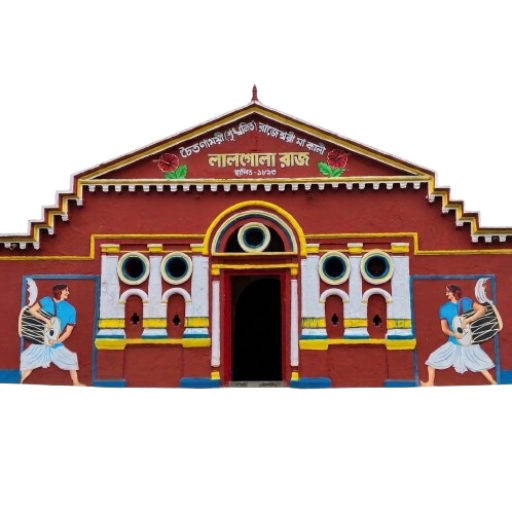
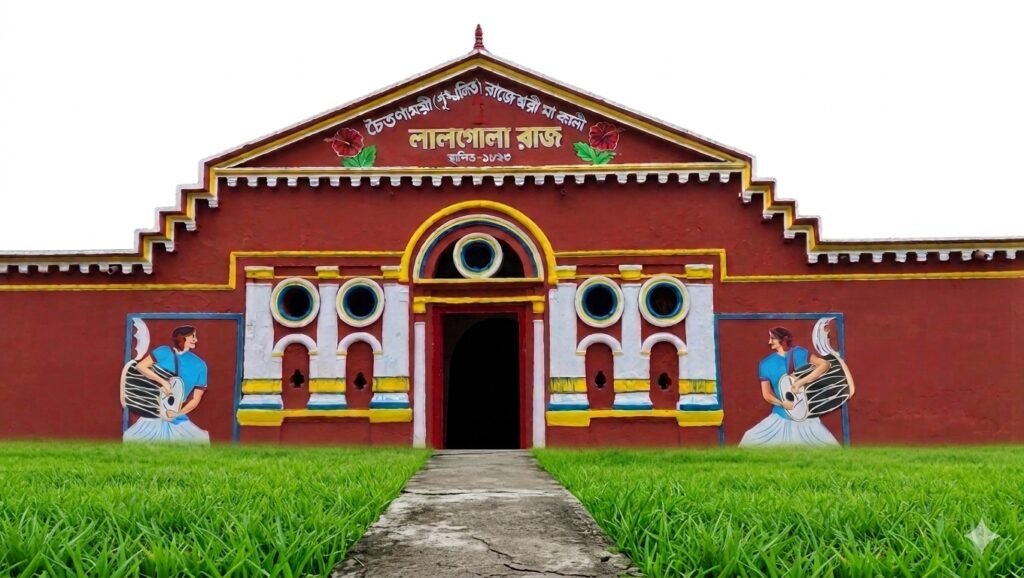
[Tradition] The story of the Mother of Lalgola’s Kalibari begins with a dream. It is said that one night Rao Ramshankar Roy dreamt that Devi Rajarajeshwari was waiting on the sandbank of Kolkoli, and that he must bring her to the Rajbari and install her there. People say the Mother was once worshipped somewhere in Malda, and drifting with the river’s current, came to rest on a char of the Padma. Obeying the command, a pucca hall was built in front of the Rajbari, and the Mother was enthroned within it.
How long ago did this happen? There is no single answer. One report mentions 1790; another says “more than two hundred years”; and in 2025 the purohit himself said that an exact year cannot be given—people say about three and a half centuries. As no written deed has been published, we record every version. That is the honesty of tradition.
[Tradition] The Mother’s form is distinctive too. It is said that Lakshmi and Saraswati stand beside her; one hand holds a sword, another grants blessing and fearlessness, and the other two are held in a clapping gesture. She is offered rice, and by old custom, hilsa—a true mark of Bengal’s river culture. Local belief holds that at the feet of the Mother whom the river brought came Bankim Chandra, Nazrul and Ramendrasundar Tribedi.
4. The Sannyasis’ Promise
From 1763 to 1800—for nearly four decades—the Sannyasi-Fakir Rebellion swept across Bengal. Driven to despair by the oppression of Company rule and by famine, Hindu sannyasis and Muslim fakirs took up arms. The names of Bhabani Pathak, Majnu Shah, Musa Shah, Chirag Ali and Debi Chaudhurani are remembered to this day.
[Tradition] A tale told in Lalgola says that during this time a band of sannyasis from Dinajpur was passing this way. Their leader handed over the deities they worshipped to the local zamindar—Sri Rama, Sita, Lakshmana, Hanuman, Radha-Krishna and several shaligram shilas. He said they were going to join the rebellion, and that if they did not return within a set time, the deities would belong to the zamindar. They never returned. The zamindar built a temple for Raghunath to house the deities, and it stands to this day close to the Kalibari.
Lalgola’s folk memory therefore speaks of an unfinished promise. The fire of the struggle slowly died out, but its ideal was not lost—in popular belief it returned as a word, as a mantra. A few generations later, a writer took shelter on that same ground, and he would make the story of the sannyasi rebellion immortal in Anandamath (1882) and Debi Chaudhurani (1884). And we must remember that this rebellion was a shared struggle of Hindu sannyasis and Muslim fakirs; that unity in history is Lalgola’s true inheritance.
5. Bankim Chandra and “Vande Mataram”
According to official sources, “Vande Mataram” was first published in the journal Bangadarshan on 7 November 1875. The song was later included in the novel Anandamath, published as a book in 1882. Rabindranath Tagore sang it at the 1896 session of the Indian National Congress, and during the anti-partition Swadeshi movement of 1905 it became a powerful symbol. In 1950, Dr Rajendra Prasad, President of the Constituent Assembly, announced that “Vande Mataram” would be honoured equally with “Jana Gana Mana”.
[Tradition] Alongside this national history, Lalgola cherishes its own memory. According to local tradition, towards the end of 1873 Bankim Chandra stayed at the Rajbari under the shelter of Raja Jogendra Narayan Roy, visited the Mother’s temple, and on the night of Maghi Purnima in 1874 the words “Vande Mataram” were first spoken by him on this very soil. Establishing the details will need more documents, letters, contemporary newspapers and research. Careful presentation does not weaken this claim—it strengthens it. Lalgola’s connection deserves preservation, research and discussion.
6. Nazrul, Barada Charan and Cultural Harmony
The Mahesh Narayan Academy holds a special place in Lalgola’s cultural history. The school’s own history names Sri Barada Charan Majumdar as its first headmaster, speaks of his yogic practice, and lists Kazi Nazrul Islam among the distinguished figures associated with the institution. Bengali writings discuss a guru–disciple relationship between Nazrul and Barada Charan; its exact period and extent need further research.
Though born into a Muslim family, Nazrul composed countless Shyama Sangeet, bhajans and kirtans, while also bringing new life to Islamic devotional songs. His work crosses the boundaries of religion to speak of human emotion, love, rebellion and the spirit of the Mother. The memory of Nazrul in this precinct of Maa Kali is therefore a celebration of Bengal’s shared cultural inheritance.
7. From Memory to Responsibility
The past is not merely an ornament of pride; it is also a responsibility. Our aim is to document the temple’s architecture, the sacred image, its traditions of worship, the memories of the Rajbari, the deities of Raghunath Jiu, the history of the river routes, and the town’s learning and music—and to carry them in simple words to a new generation.
Centred on the sacred presence of Maa Rajarajeshwari, may Lalgola become a place where devotion leads people to history, history reminds them of responsibility, and heritage helps future generations know their roots.
If you have old documents, photographs, letters or reliable information, please contact us. We are committed to publishing only verified information.